Addition (Intro / terms)
What is addition?
Addition is a mathematical operation where two or more numbers (called addends) are combined to form a total or sum. The symbol used for addition is the plus sign (+).
Words Used in Addition:
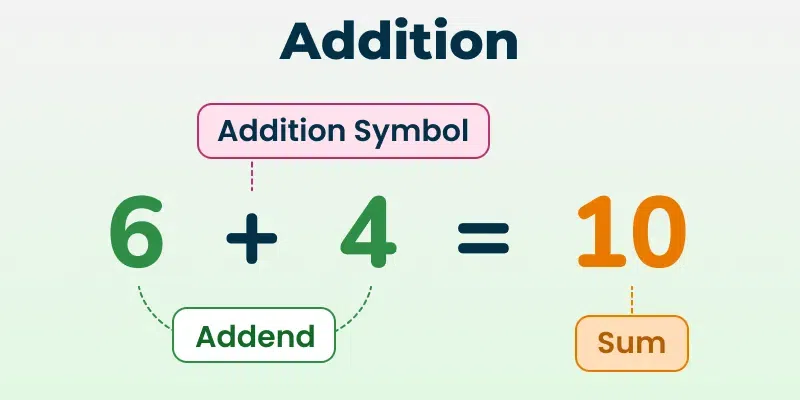
- Addition: The act of combining numbers together. It’s the operation we perform when we use the plus sign (
+).Example: "Addition is a basic operation in math." - Plus: A word that indicates the operation of adding two numbers.Example: "Three plus four equals seven."
- Add: A verb that means to perform the addition operation.Example: "Please add the numbers together."
- Sum: The result or answer you get after adding two or more numbers.Example: "The sum of 2 and 5 is 7."
- Addend: The numbers that are being added together.Example: In 2+32 + 32+3, both 2 and 3 are addends.
Total: The term total can refer to a complete or overall amount.
Operator: A symbol that represents an operation, such as addition, subtraction,
multiplication, etc. In the case of addition, the operator is the plus sign (+).
- Example: In 2+32 + 32+3, the operator is the plus sign (
+).
Example of Addition:
If you want to add 5 and 3, the process looks like this:
- 5 (addend)
- + (operator)
- 3 (addend)
Result (sum): 8